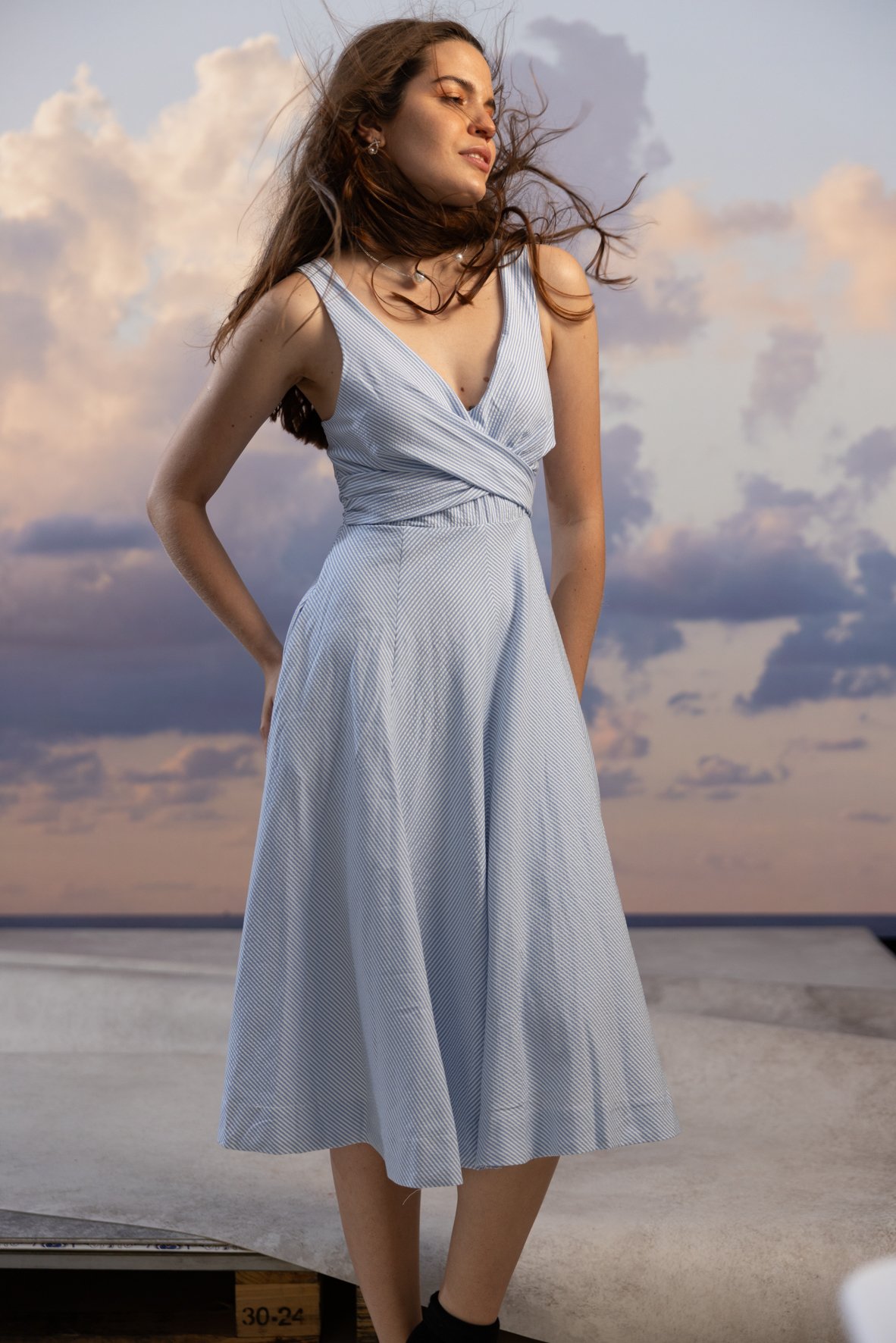
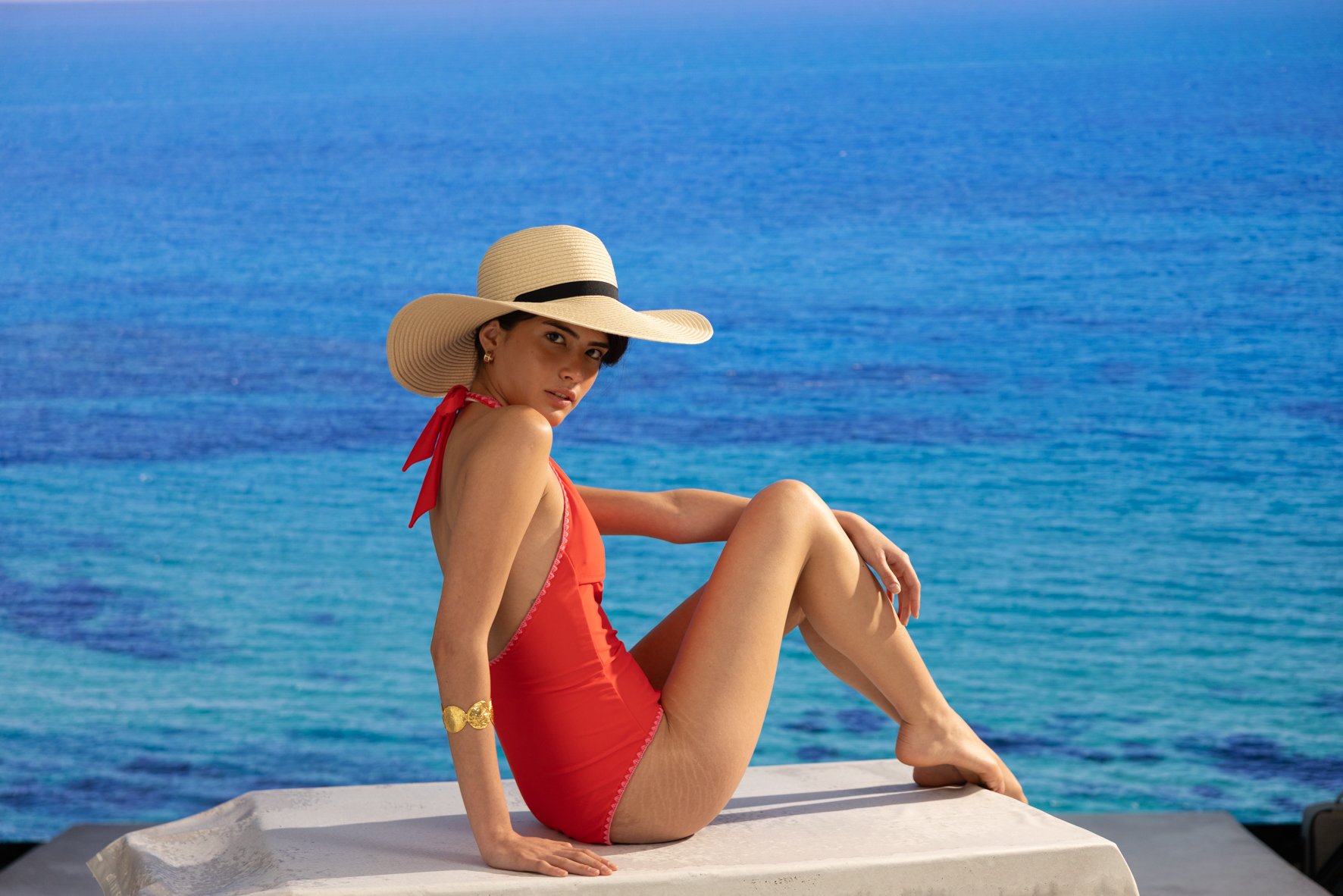
The proof of concept behind everything else in this set. Shot at Twickenham Studios with Quite Brilliant, this is the case study that established SSD's cost, carbon, and creative methodology — three matching location backdrops, one LED stage, one shoot day, measured against a like-for-like traditional location shoot.
Twickenham Studios, with Quite Brilliant (VP technical delivery) and National Trust. Models via J'adore Models and Nemesis Models. Retouch by Jane Underwood. Camera and display partners: Canon, Samsung, Profoto, AJ's.
The premise
One stage, three locations, one measured comparison.
This is the case study every other playbook in this set builds on. Rather than describe the benefit of virtual production in the abstract, we ran the same creative output two ways — a traditional business-as-usual (BAU) location shoot, and a virtual production (VP) equivalent — and measured both against cost and carbon, using the same three location backdrops: Basildon, the Cliffs, and Barcelona.
Placeholder images — this build uses stand-in photography while we source the real Twickenham files. Swap-in is a same-filename replacement once available, no rebuild needed.
Plate 01
Basildon
The first of three matching backdrops used in both the BAU and VP comparison shoots — chosen to represent an ordinary, accessible UK location that would otherwise require a full location day, permits, and crew travel.
Location one of three
Why it's here
Represents the baseline case: a straightforward domestic location, useful for isolating the cost/carbon delta of travel and set-build alone, without the added complexity of international logistics.
Plate 02
The Cliffs
A coastal backdrop bringing texture and scale into the comparison — the kind of location that typically demands weather contingency, insurance, and a longer location day in the BAU model.
Location two of three
Why it's here
Coastal/cliff locations carry some of the highest BAU contingency costs (weather insurance, access, safety crew) — making the VP comparison particularly stark for this backdrop.
Plate 03
Barcelona
The international leg of the comparison — in the BAU model, this backdrop alone accounted for the majority of crew travel emissions (7 crew round-trip = 3.19 tCO2e). In the VP model, the same creative output required no flights at all.
Location three of three
Why it's here
This is the backdrop that makes the carbon case clearest: international travel is the single largest line item in the BAU carbon breakdown (73.7% of total, mostly flights), and it disappears entirely in the VP model.
Cost comparison
BAU vs. VP, same creative output
Figures below are SSD's own operational comparison for this shoot, based on 2025 UK VP market rates and Digital Catapult cost data — not a hypothetical.
£45–60KBAU cost per shoot — 3 days shoot + travel, hotels for 7 people across 2 nights, location + permits + transport, weather/travel insurance.
£35K+VP cost per shoot — same crew, no travel days, LED stage at £15K/day, multi-scene flexibility (Basildon → Cliffs → Barcelona in one day).
£20–25KTypical saving per shoot (40–50%), plus 30 hotel nights avoided and 80–95% reduction in set-build spend.
Schedule
1 stage day replaces 2–3 location days — the flexibility to move between Basildon, the Cliffs, and Barcelona without breaking for travel is what compresses the schedule.
Carbon comparison
4.67 tCO2e vs. 1.58 tCO2e
This shoot reduced operational carbon emissions by 66% compared to a like-for-like location shoot, based on AdGreen methodology (Climatiq emissions factors) — 3.09 tCO2e avoided, for the same creative output across all three backdrops.
73.7%Share of BAU emissions from people transport — mainly flights (Barcelona round-trip for 7 crew = 3.19 tCO2e alone).
47.5%Share of VP emissions from people transport — local car/train only, no flights required.
38.0%Share of VP emissions from data storage — the largest single VP line item, reflecting the shift from travel-based to digital-based footprint.
Methodology
Calculated via the AdGreen Carbon Calculator. Scope included: crew transport, accommodation, on-location/studio energy, catering, digital storage, equipment transport. Scope excluded: manufacturing/lifecycle emissions of equipment, LED wall, computing infrastructure, studio building footprint, rebound effects — this is an operational comparison, not a full lifecycle assessment.
Plate reuse economics
First capture of a plate costs roughly 529 kgCO2e; a second use of the same plate roughly 265 kgCO2e; further reuse roughly 106 kgCO2e. Emissions are fixed at the point of capture — reusing a plate avoids creating new emissions entirely (GHG Protocol basis).
Technical configuration
What makes the comparison hold up
The cost and carbon numbers above only work because the underlying capture technique is genuinely sound — not a shortcut that sacrifices quality to hit a number.
CalibrationThe "sweet spot" — backplate quality/resolution, LED pixel pitch, and camera distance aligned together. No single factor creates realism alone.
FlooringFour standard solutions in rotation: physical floor build, composited floor via retouch, generative-fill (flagged as consistency risk for PLP/PDP), or embracing the studio floor artistically.
Flipped-plate lightingUsing the background plate itself as the primary light source, colour-matched to the environment — ~20 minutes saved per lighting change, 95% lighting consistency across shots.
Digital asset funnelThe same VP setup serves Social, PLP/PDP, Elevated, Editorial, and Campaign tiers without rebuilding the set for each.
Calibration in practice
Third-party benchmarks
Cited, not SSD's own figures
Independent data points referenced alongside this shoot's own results, for context.
BCG, 2023
40% average cost reduction from replacing travel shoots with in-studio VP. 30–45% ROI uplift from reusing VP environments across campaigns.
Deloitte, 2024 / SSD, 2025
20–30% productivity gain from parallel stills + motion capture on LED stages. 0% wasted travel/set-build cost when fully virtual.
5Cs
Read against the SSD framework
This shoot is where the 5C framework was first proven out in full, across all five lenses.
Cost
£20–25K saved per shoot (40–50%), 30 hotel nights avoided, 80–95% lower set-build spend.
Creative
Three location backdrops, one stage, one day — multi-scene flexibility with no loss of visual range.
Carbon
66% operational emissions reduction (AdGreen methodology) — 3.09 tCO2e avoided for the same creative output.
Culture
Upskilling the team in VP technique with Quite Brilliant built creative equity that now underpins every case study in this set.
Compliance
Claims are boundary-scoped and AdGreen-verified — no "carbon neutral" or "net zero" language without full lifecycle proof.
Credits
SSD team & partners
Full credit list for this shoot.
Helen Labourt — creative direction, brand strategy
Nathan McDowell — virtual/creative direction
Alice Timms — sustainability strategy, metrics
Kelsey Farish — legal, brand strategy
Nick Brincat
Jane Underwood — retoucher
Quite Brilliant — VP technical delivery
National Trust — location partner
Twickenham Studios — stage
Canon / Samsung — camera partners
Profoto — lighting
AJ's
AdGreen — carbon methodology
J'adore Models / Nemesis Models
Circular Earth
Close
The methodology every other playbook in this set builds on.
Every case study that follows — Kate Shoot 1, Mediterranean Summer, Mel & Marco, and beyond — is read against the cost, carbon, and creative benchmarks first established here.
 Virtual Production